Saturday, February 8, 2014

Backwater touring

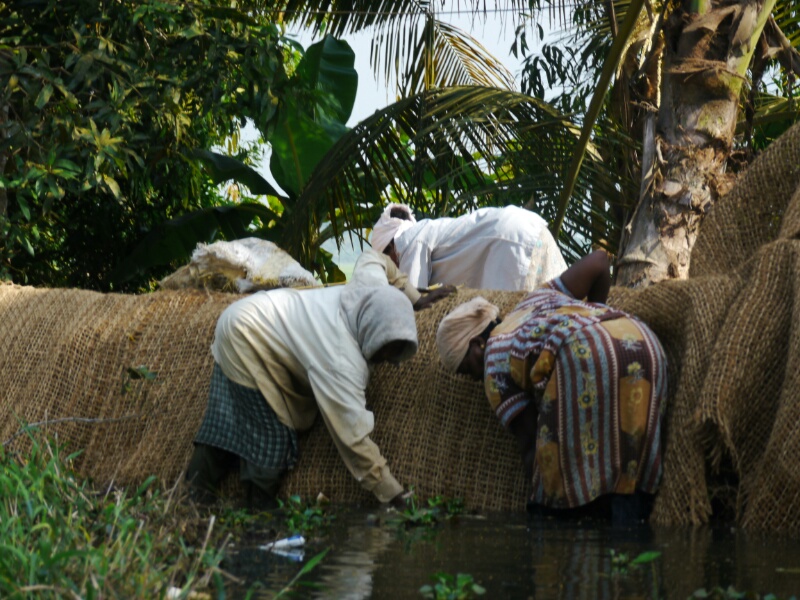
The big attraction on Kerala's coast is backwater touring,  and Alleppey is ground zero for it. When you arrive by bus, touts will descend on you brandishing beautiful but faded pictures of houseboats. The iconic Kerala houseboat looks like a huge wicker basket mounted on a barge,  but these aren't actually the best way to see the backwaters because they can only travel the big canals,  like a convoy of monster trucks on a freeway.

We got a Sikkara instead. That's a small narrow boat with an outboard motor on one side,  a sun roof,  and a few seats. It can go where the big boats can't, where village life is undisturbed by the wicker basket behemoths. Sikkaras are slow but quiet; in five hours we could see only a small part of the enormous network of canals,  rivers,  and lakes. Sikkara tours cost a small fraction of proper houseboat tours because tourists are stupid.

Friday, February 7, 2014

The heat of Alleppey

Alleppey is a town on the coast,  south of Cochin. It has nothing to do with Aleppo. Alleppey is mostly known as the best place to explore Kerala's backwaters,  an extensive network of waterways spanning thousands of kilometers. While the hills are dry and cool, the coast is hot and humid.

Getting there involved another six hours in Kerala's crowded public buses,  except this time it was downhill from an altitude of 1000m so it went much faster. The driver didn't drive so much,  we hurtled,  sometimes a hand's width from slower or oncoming traffic. This is easy and safe because everybody has a loud horn. Another one of those essential Indian experiences,  it just wouldn't be the same thing if there were such things as safety distances,  speed limits, or fear of turning into oncoming traffic. Traffic laws are for wimps. Bus drivers are the kings of the road because of their size and mass,  and they know it.

Alleppey is a mid-size city with a layout defined by two parallel rivers,  where the boats wait for tourists.  We'll rent one tomorrow. On the sea side end there's a wide beach with a ruined pier,  good for watching the sunset. 

Wednesday, February 5, 2014

Making tea

Up in the hills of Kerala they are growing tea since British colonial times. Nothing is ever flat here, and tea plantations cover the rolling hills like bright green pillows. Women hand-pick the tips of the plants for white tea and the top leaves for green tea, then someone clips the rest with shears for "ordinary" tea.

Of course they have a tea museum where they crowd tour groups into a small room to show them a movie with sappy music to explain how wonderful life was for the tea workers since the British brought tea and civilization to this poor land.

We actually went all the way to the top of the highest mountain in southern India, named Top Station with a distinct lack of imagination, in the neighboring state of Tamil Nadu. Everything is very relaxed and pastoral up in these hills -  until we came with our onomatopoeically named tuk-tuk, that is.

Oh, and the tea they serve up there is excellent.

Tuesday, February 4, 2014

Hill stations

The Coast of southern India is hot and humid, even in February. This was perceived as unsatisfactory by the British when India was part of their empire, because British weather is not like that. So they moved inland to the "hill stations". So did we today.

That meant a long tuk-tuk ride to Ernakulum, the commercial part of Cochin which holds no attractions whatever. Then a bus to Adimali, one of those local jobs, all hand-welded with no glass in the Windows and way too many seats per square meter. Five hours, but it wasn't boring for a minute.

Another tuk-tuk brought us to our resort, which we promptly left for its much nicer neighbor, the Green Shades with its spice garden. Great location and views of the valleys and forests. Banana trees and orchids grow like weeds here.

Cochin in South India

The long tuk-tuk drive from the airport to Fort Cochin early in the morning brings back memories of South India. The long lines of gaudily decorated trucks and tuk-tuks (three-wheelers) with their "sound horn" signs, the stained concrete and rusty metal, and the Indian spices in the air... The ferry that took us across the bay was exactly as grungy as an Indian ferry is supposed to be.

Fort Cochin, as cities in South India go, is surprisingly pleasant, with narrow and uncharacteristically clean streets, and many souvenir shops but it's the end of the season so it's all very relaxed. Apart from the colonial architecture, Fort Cochin doesn't have many monuments, so they make the most of what they have. On the beach are huge Chinese fishing nets suspended from cantilever that are lowered into the water, then raised to catch fish. Mostly they catch tourists now though.

Sunday, October 7, 2012

From the mountains to Hanoi

The photo shows what happens when the village youth gets their collective hands on a tablet. First they win three consecutive Solitaire games, and then they guide a knight to victory against fire-breathing zombies. A normal day in the village.

I took the night train to Hanoi and spent the day there. At dawn I watched people at the lake in the center of Hanoi do their morning gymnastics, T'ai Chi, weight lifting, and mass back massage. After the days in the remote village up north it's odd to be in a place with traffic, tourists, cafes, and password-protected WLANs - in Lao Cai at the train station they are all unprotected. I know Hanoi, I don't need a guide here. I can practice my street-crossing skills again: at the right moment, just walking into traffic, oblivious to the endless swarms of motorcycles, walking at a slow steady pace and watching the traffic flow around me. Becomes second nature quickly, but it would get me killed in Berlin.

Speaking of which - something has come up and I need to return home. Besides, I need to recover from this braindead blogging app by Google. My plans to see Taiwan and the Philippines will have to wait. This blog will be silent for a while but expect more stories in the future!


Rural life in Vietnam

A friend invited me to his family's home in a small village in the mountains of northern Vietnam, close to the Chinese border. I was welcomed at a small homestead by three generations for three days. The house is built from bamboo cement and wood. They have six dogs, three cats, two buffalo, two pens of pigs, and flocks of chickens and ducks. Meals are eaten on mats on the floor, with a view of the fields and mountains surrounding the house. For the last dinner, one of the ducks had to die. One of the small children was gnawing on the duck's head all evening. Animals are not pets, they serve a purpose.

Amenities are basic, but there is a hot shower (a bucket filled with hot water), a kitchen with an open fire, opulent wooden furniture, a TV running at all times, and a scenic outdoor toilet behind the pig pens. It's all very homey and comfortable. There is electricity but no Internet anywhere. (Hence you'll be reading this after I return to Lao Cai.) I had a wonderful time there, everyone really made me feel at home. In a Vietnamese family, people do not disappear into their own rooms.

We spent the days visiting the surrounding villages, friends of the family, a market, and generally following the beautiful trails between the hills and fields. The harvest will begin in two weeks, so the men in the villages have time to play dominoes and card games. Wherever I go, everyone stops what they were doing to stare at me. I am the first western tourist visiting these remote villages, ever, and people are curious about my size - I am at least a head taller than everyone else -, the hair on my arms, my camera, and my lack of Vietnamese vocabulary beyond hello, good bye, and thank you.


Wednesday, October 3, 2012

The trail to Vietnam

Why is it that every next leg on my journey requires taking a bus at six o'clock in the morning... And one of those local things, built for people a head smaller than me. And the local buses always operate in "never full" mode... Anyway, to my surprise they run a direct bus from Muang Khua in Laos to Dien Bien Phu in Vietnam. The border formalities were easy. One of the border policemen pulled out his wallet and offered to change kip to dong with a really horrible exchange rate. Moonlighting as a currency scammer, how exotic.

Dien Bien Phu is known as the place where the French lost a major battle against the Viet Minh guerilla, and afterwards pulled out of Indochina. It's a modern town with some nice war memorials and museums but I didn't come for those, so I got on a bus to Lai Chau in the very far north of Vietnam, using highway 12. Which turned out to be a rutted trail full of potholes, deep mud, and big rocks. It's too narrow for passing, so I saw a lot of daring maneuvers that are not  commonly seen on European roads. This is odd because in general the roads in Vietnam are excellent. Once we forded a river in the bus, with steam rising up from the hot engine where it touched the water.

The reason to do this trip was the fantastic mountain scenery, following deep valleys and lakeshores, in never-ending twists and turns up on the edge of the mountains. We lost a few hours waiting for road crews resurfacing the road, with absolutely no discernible success, but it was fun to watch them kick huge rocks into the river from high up. Spent 14 hours in the bus.


Tuesday, October 2, 2012

Travelling the Nam Ou river

The Nam Ou is a tributary of the Mekong, coming from the mountains in the north and joining the Mekong near Luang Prabang. I am hoping to cross the border to Vietnam there, and travelling on the river is the most scenic way there. I had to stop at Muang Ngoi, a small village stretched along a single dirt road,  and spend the night there because upriver travel is slow. They have no Internet, no cell towers, and no electricity except for a few generators that run for a few hours in the evening. The guesthouse charged €3.50 per night.

This morning I wanted to go further up the river, to Muang Khua, but the boat won't go with fewer than 10 passengers and I was alone. So I chartered the entire boat. Being a rich farang has its upsides. (Farang comes from "français" and means foreigner; all foreigners are automatically assumed to be rich.) So I actually made it. Muang Khua is tiny but they have electricity and an Internet café. Actually it's a bicycle repair shop with an Ethernet cable hanging from the ceiling, but I travel with a small access point for cases like this to connect my tablet.

Unfortunately the bus to Dien Bien Phu in Vietnam only goes in the very early morning so I have to stay another night in Laos. And I don't actually know if foreigners are allowed to enter Vietnam in this very remote corner of the country, cross your fingers...


Sunday, September 30, 2012

Luang Prabang

Luang Prabang is the jewel of Laos, the land of the one million elephants. (Except they killed off most of those.) This town is home to buddhist monastery at nearly every major corner, with beautiful wooden pagodas painted with gold. The tree-lined streets are quiet, narrow, and lined with wonderful French colonial architecture, with no more than two floors. Simple restaurant terraces overhang the shore of the Mekong river. During the high season, which will begin around November, tourists flood Luang Prabang, but it somehow maintains its charm and dignity. Luang Prabang is far richer than its neighbors due to the money the tourists bring, but the money hasn't done damage. Needless to say, there are no Western chain restaurants, or in fact any Western stores, in town. Luang Prabang has the same charm as Hoi An in Vietnam, which embraced tourism too but did not sell out either.


Saturday, September 29, 2012

Mekong cruise

It takes time two days to travel on a slow boat from Houay Xay to Luang Prabang. I went with a first-class cruise that stopped at a number of villages, all very simple affairs made from woven bamboo and wood on stilts, with children and animals running around on the dusty paths. The river is winding its way between green hills, making it more scenic than the delta. The Mekong is also much narrow here and flows faster. There is almost no sign of human activity; just an occasional boat at the shore, and fishing rods perched on the rocks in the water. The few villages have no road access, their life focuses on the river. It's all very tranquil and simple. The delta, in comparison, is buzzing with small and large boats.


Friday, September 28, 2012

For one euro to Laos

Two hours in a very authentic local bus brought me to Chiang Khong this morning. Not much to do there: one street, no traffic lights, two monasteries. Small wooden longboats ferry passengers across the Mekong river to Houay Xay in Laos, for one euro, where it takes a few minutes to "check in" to Laos. Houay Xay is a small village as well, but more scenic with a small hill with - what else - a monastery on top. It feels poorer but friendlier than the Thai side. First I had a light lunch, paying fifty thousand kip. One of those currencies with way too many zeroes.

There's a local volunteer aid program for local villages in Houay Xay, called Project Kajsiab Laos. (See Facebook.) They operate a guesthouse and restaurant, and I went to their communal dinner and chatted with the volunteers until late.


Wednesday, September 26, 2012

The Golden Triangle

Last stop in Thailand: Chiang Rai is a smaller version of Chiang Mai without the traffic. It's at the south end of the Golden Triangle in the border area between Thailand (check), Myanmar (check), and Laos, where I'll be tomorrow. The attraction here is nature, with waterfalls, forests, mountains, and rivers, but this time it's just a convenient stop on the way to Chiang Khong at the border.


Tuesday, September 25, 2012

Chiang Mai

It's a long train ride from Bangkok to Chiang Mai in the north of Thailand, over 14 hours - in part because the tracks were damaged during the monsoon season this year. The first-class sleeper ticket was a good investment. Chiang Mai is Thailand's second-largest city, after Bangkok, which is fifty times larger by population. The center is a square of nearly 4 km^2, enclosed by a moat and some remains of the old city wall. Main streets are busy and unattractive, but the numerous curving side streets instantly teleport the visitor to tranquil and green village life. Of course, buddhist temples with their golden shrines abound, including the enormous ruined stupa in the photo. A picture of the revered King of Thailand is always near. People are much more open and friendly than in busy Bangkok. The big thing here is trekking to hill tribe villages, river rafting, elephant riding, paragliding, and other adventure sports, but I had done much of that during two previous visits so I took it easy this time.