Saturday, February 7, 2015

Boracay

Boracay is a small island but one of the most beautiful destinations in the Philippines. The sand is white, the weather is balmy, people walk barefoot on the two-kilometer beach promenade shaded by palm trees. There is a dive shop every fifty meters, and the dive boats have trouble finding a spot to park on the beach.

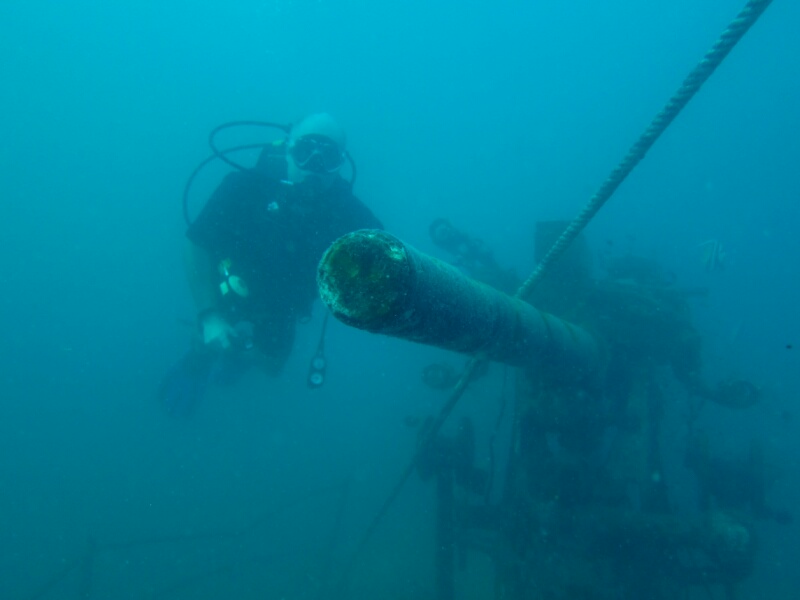
My first dive this morning was a big wreck at 30m, with several paths below deck that are safe for divers. It's an interesting experience to float down through the hatches and float through the passages below deck, where people have once worked and schools of fish now seek protection.

Boracay has its darker side too: the road running through the middle of the island is just as congested, noisy, and filled with smog as Manila, only it's the two-stroke tricycle engines that produce the filthy air. Getting here wasn't easy either, after a sequence of jeepney and van rides down the coast of Mindoro I found myself on a rust bucket of a ferry for four hours to Caticlan, arriving to late at night to catch a boat to Boracay. So I spent the night in a tiny room with a bricked-up window and a comfort room that allowed no feelings of comfort. "Comfort room" is the local euphemism for bathroom or toilet.

Thursday, February 5, 2015

Diving in Sabang

Sabang is a typical beach town. Laid-back, slow, sunny, and not very crowded (a fact that has the shopkeepers very worried). The big business here is diving, and keeping the divers supplied with alcohol in the evenings.

I went out with a very relaxed long-haired dive master ate South Sea Diving who has been here for 30 years. They have a beautiful reef with colorful soft corals and fairly good visibility, just a few minutes by boat off the beach. Many fish, but no large ones. The first dive was a drift dive, meaning it's hard to stop and look at things close up, like the wreck we were passing. It's essentially a side scroller.

The dive master complained that the water was very cold, only 26 degrees C, but someone told me that it's even colder at home in Berlin. Hard to believe, sitting here at the beach sipping pineapple shakes.

Wednesday, February 4, 2015

First beach

The Philippines consist of many islands and countless beaches. I am going to visit a few, beginning with Puerto Galera, the galley bay. Getting here from Vigan took 15 hours by bus, van, and ferry. This is going to be a short post because I need to catch up on sleep, but I still wanted to show the shivering folks at home some subtropical beach photos. Enjoy!

Tuesday, February 3, 2015

Vigan Food

I don't like Vigan food.  It's mostly deep-fried greasy animal pieces, like pork belly and sausages that resist description. I don't see people visiting the Philippines for the food.

Vigan,  the city,  is very pleasant. Its entire downtown has completely preserved Spanish colonial architecture.  A Spanish traveler I have met has felt right at home, right down to the details. Except that many of the buildings could use a touch of paint and maybe a roof. The weather is balmy and sunny. It does appear that the city's entire Internet traffic,  including mobile, runs through a single slightly psychotic router though.

Monday, February 2, 2015

The Cordillera mountains

Another short seven-hour gut-wrenching bus ride up the mountains brought me to Sagada, a tranquil village in fantastic scenery that just so happened to be in the middle of a festival with competitions, music, and other events. They have UNESCO-protected rice terraces nearby, waterfalls, and caves. I spent much of the day hiking, although frankly, Longshen in China and Sapa in Vietnam - both described elsewhere in this blog - are more impressive.

There is more in neighboring villages like Banaue, where the rice terraces date back two millennia. Unfortunately, the mountain region is already quite chilly and the weather forecast is soaked with heavy rain for the rest of the week.

So, I got up early today and used a series of jeepneys, vans, and buses to pass through Bontoc, Cervantes, and Tagung to Vigan on the coast. The connections were untypically perfect, and I am now back in a subtropical sunny climate. The roads were unbelievably scenic, through craggy mountains, deep valleys, and lush forests; unfortunately there is a law of nature that photos taken from a moving bus are never any good.

Sunday, February 1, 2015

North of Manila

Manila is a huge, congested, and noisy city filled with smog, so I caught a bus North to escape to the hills. Baguio turned out to be a small, congested and noisy city filled with smog. I think it's the jeepneys: essentially an ornately decorated stretch jeep with a long passenger cabin, emitting great clouds of diesel fumes.

But Baguio has its upsides too: it's much cooler, and it has a leafy Park in its center with open spaces, fountains, a lake packed with boats, and even a bumper car ride. It seems that everyone is out in the evening to enjoy it. Baguio also has the inevitable outdoor markets. As a city it's otherwise pretty desolate though, and almost all the restaurants I found are US fast food chains or local copies. Well, I only went here because it's the gateway to the Philippine Cordilleras...

Saturday, March 1, 2014

Party town

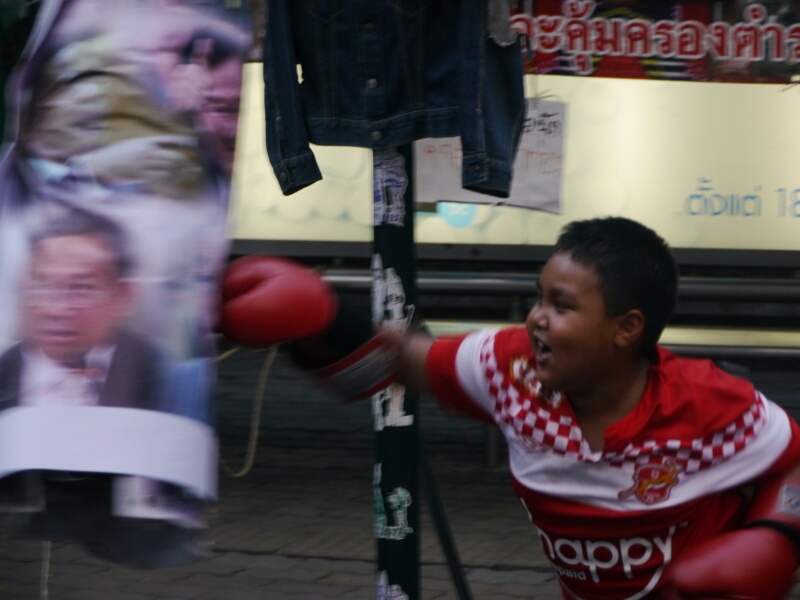
There's trouble in Bangkok. Protesters want to overthrow the democratically elected president, an emergency election was disrupted, the major traffic arteries are blockaded, a state of emergency was declared in Bangkok, and the army is patrolling the streets. Sounds dangerous, does it?

Well, no. It might have been if this were Tunisia or the Ukraine, but Thailand doesn't work like that. There's bahts to be made. Those blockades are essentially street markets of tightly packed stalls selling food, watches, cell phone contracts, T shirts, whistles, and souvenirs. Bands play music in front of big video walls. Parents carry their children on their shoulders, tourists take pictures, and the police diverts the traffic.

This is how revolutionary parties push their slogans in the 21st century: they print it on iPhone covers and sell them to the tourists. Welcome to Thailand, long live the king!

Thursday, February 27, 2014

Sail Rock

Sail Rock is a small rock pillar north of Ko Pa Ngan, and perhaps the most popular diving site here. Fish are so plentiful that they formed tornadoes around me so large that they obscured the light from the surface. I was hovering in huge clouds of silver and yellow fish, among them barracudas a meter long. Visibility was excellent.

Sail Rock has a chimney: divers enter at a depth of 18m, and ascend along an irregular shaft to 6m. Really too bad that these were my last dives; tomorrow I'll leave the island.

It's easy to shock the locals: I claim to be American and ask where to stow my harpoon and explosive-tipped bolts. Before I actually started diving, most of what I knew about it was from watching James Bond movies, and you never know when you need to blow a shark or enemy submarine out of the water. But this is not a joke that Thais appreciate , diving is all about conservation.

The island of Ko Samui itself is not very exciting anymore. When I came here for the first time over 15 years ago, it was a simple paradise with few luxuries. Now resorts block access to most of the large beaches, there's a KFC and a McDonald's, and everyone drives around in obscenely big pickup trucks. When probing the locals, what they complain about most is out-of-control construction and - loud Russian tourists.

Wednesday, February 26, 2014

Toilets flapping

Many of the best diving sites are around Ko Tao,  the smallest of the three large inhabited islands here. My dive boat was fairly large (larger than the one in the photo),  with a lower "wet" deck for the equipment and an upper "dry" deck for rest,  meals,  and sleeping.

Diving is mostly corals, but they have also sunk various concrete structures and seeded them with corals to create artificial reefs. There are hollow concrete boxes and suspended hoops for practicing buoyancy skills, but also some steel wire structures resembling boats and houses, concrete sculptures, even stair masters and weight racks, and a family of toilet bowls with their seats gently flapping in the current.

At a depth of 30m lies an old warship, also deliberately sunk there to create a reef. Many fish have already made it their home. Divers pose for pictures at the cannon, and there's an actual line of divers waiting to swim through the bridge of the ship. Unfortunately the no-decompression time at that depth is quite short - the deeper you go,  the more air you use.

I'll post some underwater pictures later.

Saturday, February 22, 2014

Gone diving

Samui is all about beaches and water sports. Tomorrow I'll leave on a dive boat for a few days, seeing various parts of the islands.

Colombo

Colombo is Sri Lanka's largest city, and it's pretty useless as a tourist destination. Nothing much to see there, just asphalt, heavy traffic, polluted air, highways and train tracks that block most of the feeble ocean beach, and no sights or even restaurants, unless you count KFC and other foreign fast food joints in the various mall food courts.

They do have a decent National Museum with exhibits and good English descriptions of Polonnaruwa and other sites that I had seen, and the Pettah neighborhood is a picturesque grid of streets packed with small shops and frenetic activity. The eastern end is where they sell sacks of onions, potatoes, and other vegetables, and every few meters I was called in to chat and take pictures. Very friendly people.

But perhaps Colombo's nicest attraction is the international departure lounge at the airport, where I am writing this. Chatted with some airforce guys while waiting, and we performed a very Indian ritual: he now has a Berlin ballpoint pen, and I have a Sri Lanka Airforce pen. How's that for a souvenir.

Wednesday, February 19, 2014

Dagobas

A dagoba is not,  in fact, Yoda's swamp retirement home. It's a domed shrine, usually holding some Buddhist holy object. Elsewhere they are known as stupas, chedis, chörten, or by other names. The archaeological zone of the town of Anuradhapura has two of the highest, at up to 74m, but other than that it's no match for Polonnaruwa. The ruins here are more of the foundations-with-leaning-pillars kind. You need a lot of imagination to see a palace in something like that. Greek visitors will know what I mean.

Lunch can be an elaborate affair with rice and a selection of different vegetables and curries. The locals mash them together with their fingers; tourists get spoons. They are quite fond of deep-fried chicken pieces. Overall, Sri Lanka's cuisine can't touch India's.

Tuesday, February 18, 2014

Naked volcano

There was a volcano once at Sirigiya. It eroded away long ago but a 350m tall basalt plug that was the magma chamber still stands. Naturally a Buddhist meditation place was built on top sometime around the 5th century,  and now there's tourists crawling all over it. Fortunately, I was there before the crowds arrived.

There are stairs leading up part of the way; the rest is steel stairs,  walkways, and a pair of spiral staircases that allow a nice view of the sheer rock face below your feet. Halfway up are some amazingly well-preserved paintings, plus ancient and modern graffiti on a wall alongside the paintings. Plus ça change...

The view from the top is stunning.  Much of this part of Sri Lanka is a national park, and there are forests, lakes,  and mountains all around with little evidence of civilization - with the exception of a huge shiny white Buddha in the middle of the forest.

Monday, February 17, 2014

Ruins and shrines

Left the mountains to see Sri Lanka's ancient ruins, beginning with Polonnaruwa. There is an extensive site with many large monuments, most dating back 800-1000 years. There are palaces, Buddhist stupas and shrines, but also the foundations of hospitals, monasteries, and even market stalls, giving a good sense of the layout of the ancient city.

It's not as grand as Angkor's big signature temples, but some of the monuments are enormous. Among the biggest are a 54-meter brick stupa, a standing Buddha in a huge temple building, and numerous palaces and shrines. A lot of the brick structures have been repaired in modern times; this is documented in an excellent museum attached to the site.