Monday, March 13, 2017

Sex sells

My hotel in Khajuraho is so much more pleasant than the one in Gwalior! I have a door that leads into their beautiful garden. It's also only a few minutes from the Western Temple Complex.

Khajuraho has 22 temples, all a thousand years old and in almost mint condition. The ornamentation, the multiple bands of statues all around the temples, the friezes with elephants and warriors, and the interior is almost perfectly preserved, in sharp detail with almost no weathering. No surface here is flat, other than the floor. It's absolutely incredible, and a UNESCO world heritage.

The statues are not quite what you would expect in, say, a church. There are various gods, and thousands of curvaceous women in exotic dancing poses - this has got to be bad for the back, especially for women as top-heavy as these! And it doesn't stop there, many panels are clearly taken for the Kama Sutra, with a preference for the more complicated poses, and some are just orgies in sandstone.

We are lucky that the Mughals never took control here; Islam is even more prudish than Facebook and would have wiped out this architectural wonder.

Sunday, March 12, 2017

Datia Fort

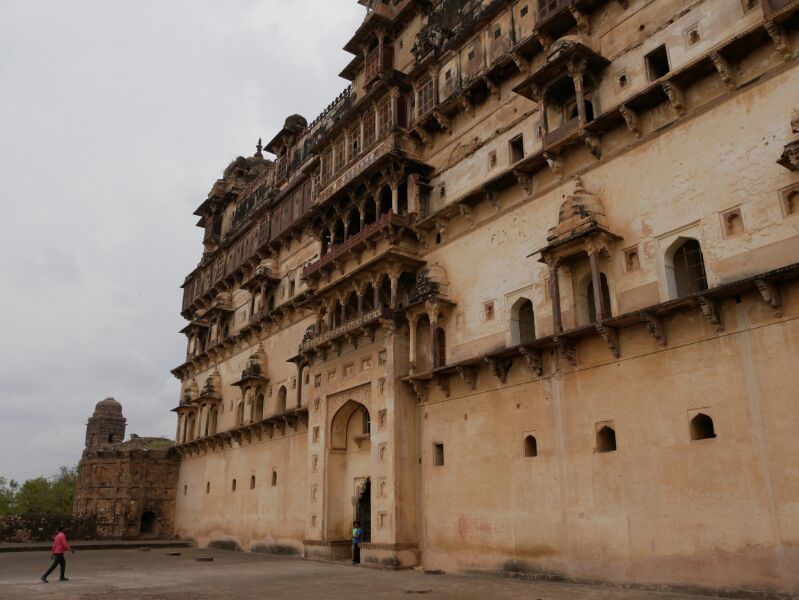
Between Gwalior and Khajuraho is a small rural village with a huge hulking Fort, at Datia. The entrance leads to a series of big dark caverns and wide stairways and arches, more felt than seen in the darkness. Two floors up it opens to a large square with connecting walkways, in various stages of charming disrepair. The central tower rises up to seven floors. Balconies with stone grilles look out far over the countryside. Some rooms still have the original paintwork. One large hall, the painting gallery, is behind heavy wooden doors locked with a massive chain and padlock. I know the door is heavy because the guard picked it up and heaved it to the side so I could enter, without paying any attention to the lock. This place was very beautiful before it was abandoned.

Sun State

The Sun State Hotel in Gwalior is the second-worst hotel in the world. Its business is tip extraction. First the guy who didn't carry my bag for carrying my bag, then the guy who replaced the unused towel with another unused towel for replacing my towel just after getting to the room. The room has hot water but the hot water isn't working so I got a bucket. Much later someone unlocked the door I had locked and stood in the room demanding a tip for that too. There are soggy bricks in the bathtub that fell from a hole in the ceiling.

(The prize for the worst hotel goes to that windowless cell with half-collapsed ceiling in Yuncheng, China, a few years ago, where the receptionists moonlight as prostitutes and I had one standing in my room at midnight who didn't like being thrown out.)

Maharaja Palace

The big attraction of Gwalior is its big fort on top of the hill above the city. Once it was one of the most beautiful in Madhya Pradesh, with intricately carved sandstone walls, covered with mirrors and precious stones. The the Islamic Mughals came and took them all away. But some of the tiles survived, and with its many towers, arched rooms, and courtyards with carved balconies it still looks exactly as a maharaja's palace is supposed to look like. They also have a museum on site that charges 7 cents admission, but it's easily worth twice that.

Today the maharaja, when he is in Gwalior, lives in a new palace in the city. Part of it is now the Jai Vilas museum, where all the maharaja stuff is shown: fully furnished banquet halls with ten-ton chandeliers (they put eight elephants on the roof before hanging them, to test the roof), a glass model railway running down the dining room table to serve drinks, coaches, dresses, the works. I was late, and behind me they were shutting off the lights and locking every room after I left it, spooky. Outside, I met a traveler from Jaipur, check out his blog: myworldinmybagpack.blogspot.in.

Chatted with some local students in town who wanted to practice their English. One was very excited that last year, the existence of gravity waves was finally conclusively proven as predicted by Albert Einstein ("Einsteen") a hundred years earlier, and he also thought that Adolf Hitler is the beloved current king of Germany.

Friday, March 10, 2017

Driving in India

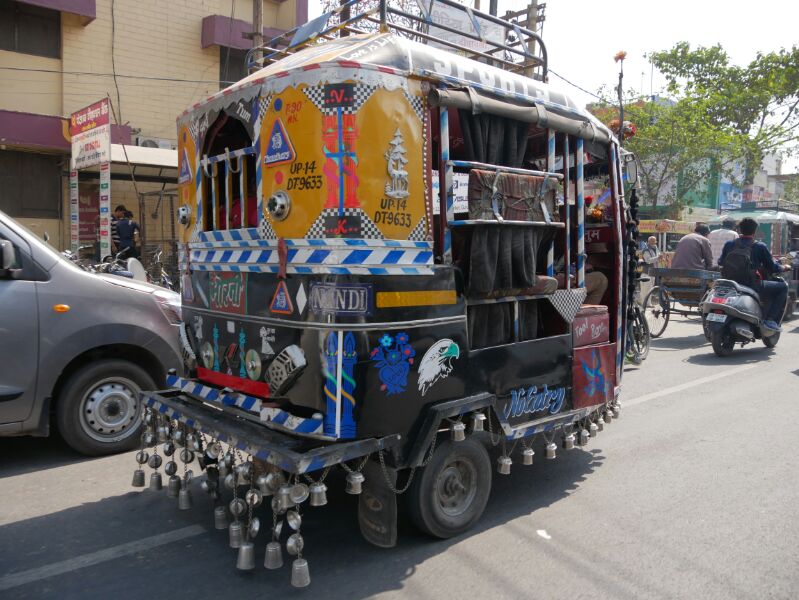
In Europe, the basic unit of traffic is the lane. Here it's any space big enough to squeeze into, at any speed, without making the next vehicle brake too hard. It's ok because people honk madly while they do this. It's also ok to make a U-turn on a divided highway and going against traffic. All this in a mêlée of cars, huge overloaded trucks, bicycles, pedestrians pushing carts, cows, farm engines pulling big bulging loads, ox carts, tuk-tuks, and everything in between. For extra excitement, there are often vicious speed bumps and pothole fields.

At night, most cars and some trucks have rear lights. The rest relies on bicycle reflectors, or a guardian god of their choosing. In the case of gas tankers I hope it's a premium god on 24-hour duty. Twisted wrecks lie on the side of the road, or are stacked in piles. And in case you are wondering: the first truck really is leaning, and the truck with the broken axle is loaded with as many butane gas cartridges as would fit, and then some.

Hill Station

Britain is an often cold and wet island somewhere out in the Atlantic Ocean, and that is how the British like it. So when they find themselves ruling a place like India, where temperatures can get close to 50 degrees C, they build hill stations up in the mountains. One of the largest ist Mussoorie, a long village stretched along a ridge with great views of the valley to the south and the mountains to the north.

At the western end is the Library, now a little shopping mall, and in the east is the Picture Palace, now a games arcade. I was wondering how they get so much honking traffic onto Mall St, which connects the two, but I am told it's actually quiet now. The place really fills up in May and June when the lower altitudes heat up.

Wednesday, March 8, 2017

Himalayas

Once again I am in the Himalayas, my favorite mountain range. Not the high peaks, these are a long way to the east, but today's trip took me to Chambra at 2000m. It's a long narrow road along the edge of the mountains that consists only of curves.

Chambra itself is a nice town, but I was lucky to get invited the a small village a hundred meters down a steep and narrow footpath. I got the grand tour; everyone in the village is related. Everything here is 300 years old, low pleasant houses built from wood and clay with no concrete anywhere. The view of the fields in the valley and the steep mountains around from the front porches is glorious. The houses rest on a ground floor tight was once use for animals, but is now storage. All the doors are very low.

Tuesday, March 7, 2017

Home of the Hippies

Rishikesh is a town further up on the Ganges. The town has a split personality: the larger part is a fairly generic busy town full of markets and honking traffic, a narrow footbridge over the Ganges connects it to the smaller part built up a steep hill. The bridge is not too narrow for motorcycles because nothing in India is too narrow for motorcycles, but the other side is still mercifully quiet.

This is stereotypically India. Long-haired barefoot hippies, who have elsewhere mostly died out, study yoga and meditation in countless little ashram hidden behind large advertisement signs in the narrow alleys. Not sure how legit this is - they also offer quick courses to become a teacher. Big business.

But up from the top of the town, there are good views of the Ganges and the hills. I am approaching the mountains now.

Monday, March 6, 2017

Gate of the Gods

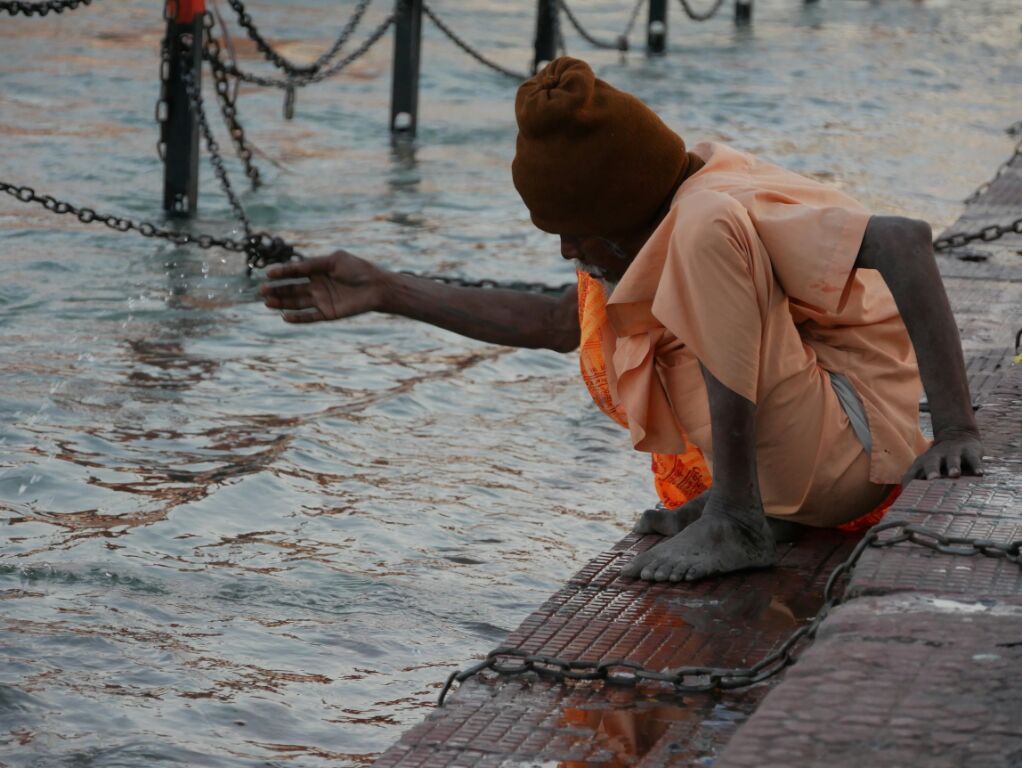
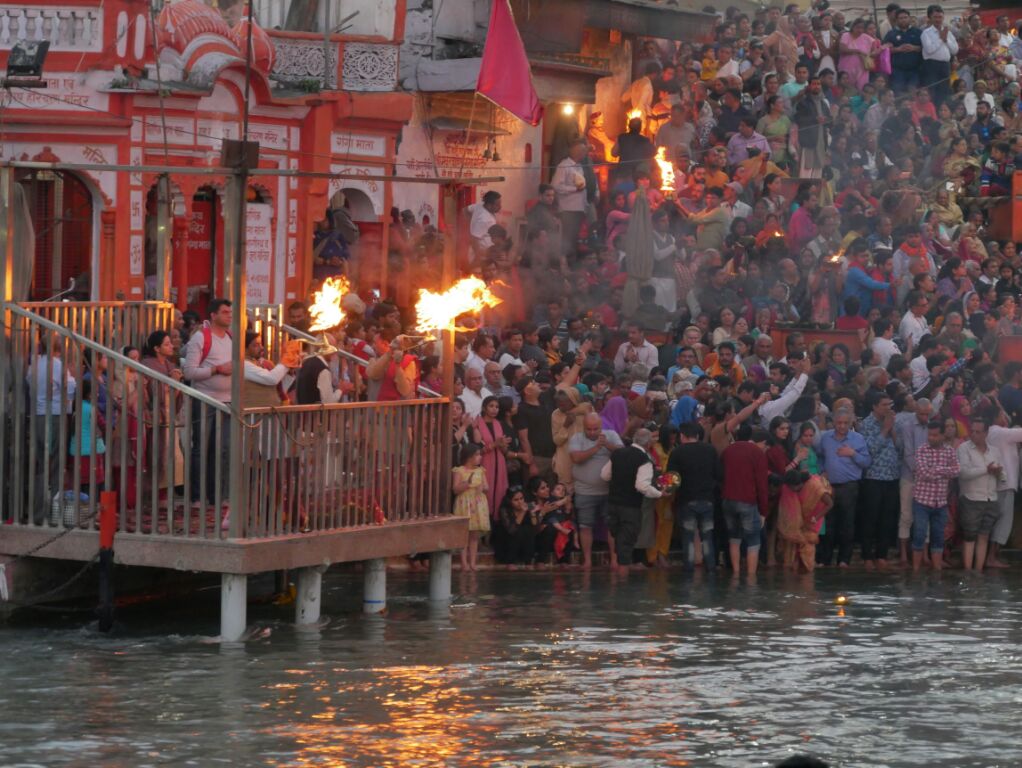
Haridwar means Gate of the Gods. It's a town on the Ganges, up the mountains where Ganges water is still clean, in eastern India. At the ghats - waterfront stairs - people go swimming in the holy Ganges because it's a shortcut to Nirvana, i am told. The river is flowing so fast that people hang on to chains hung in the water. There are almost no tourists, I have seen six today, but vendors of plastic canisters to take holy water home, official-looking people insisting on voluntary donations, and all sorts of sadhus - holy men - selling holy smoke or just pictures. A number of sadhus with bright orange faces, looking like a Chinese Monkey King or Trump or both, have hit on the racket of dabbing red powder on the forehead of anyone not ducking fast enough and charging for it. Haridwar is very clean, which cannot be said for all Indian cities, and beside the ghats seems to consist of narrow market alleys filled with people and madly honking motorcycles. On sale are mostly religious items like arm rings, starues, and colorful powders. Hindus have 33 million gods, but the most conspicuous one here by a wide margin is blue-skinned Shiva. They even have a 26 meter tall statue on the riverside. Sorry about the small pictures, here it's much easier to get a connection to Shiva than to the Internet.

Monday, September 5, 2016

Kyoto

Downtown Kyoto isn't very scenic, but the parks around it certainly are. The temples, being made of wood, have a habit of burning down and having to be rebuilt over the centuries, but the gardens around them are often much older. This includes the Arashiyama garden and the golden Kinkaku-ji temple and bamboo grove at the western edge of the city.

Thursday, September 1, 2016

Kyoto

More temples in Kyoto! Buildings are often simple wooden halls resting on large pillars, with elaborate roofs but very simple inside. Walls are white or rice paper, or occasionally painted with murals; there is very little furniture. Floors are covered with Tatami mats. Tatami mats are made from fine soft woven straw, and are so ubiquitous in Japan that they are used to measure floor space. You might hear of a six-mat room, which is about 23 square meters - slightly complicated by the fact that there are three slightly different standard Tatami sizes.

The gardens are often more interesting than the buildings. They are always meticuously landscaped, often working with huge moss-covered spaces and raked gravel ornaments. They are maintained with more care and attention than any English golf lawn; I have seen women with white gloves carefully picking clean moss gardens.

Wednesday, August 31, 2016

Imperial Kyoto

It's a little over two hours by bullet train from Tokyo to Kyoto. Kyoto is not anywhere as busy and loud as Tokyo; the highrise downtown is fairly small and surrounded by more traditional small two- and three-story houses. People visit Kyoto because it was the imperial capital before Edo, now known as Tokyo, and it still has a large number of temples and an imperial palace, many of them very scenically located on the hills to the east and west of the city. (In Tokyo, the imperial palace was almost completely destroyed in WWII, and is mostly a large park today.)

On my first day I was visiting the temples on the east side of town, across the river, that are lined up on the hills like pearls on a string. There is usually a large gate building on massive wooden pillars, and a number of bright orange or red pagodas with multiple roofs. The path to walk is carefully signed, the occasional ugly construction fences carry signs with profuse apologies, and crowds of tourists carrying selfie sticks and making V signs snap pictures of everything. But the temples are also still places of worship; people kneel and pray, sound gongs, and follow ancient ceremonies. Prayers and wishes are written on wooden tablets or small pieces of cloth, and tied to racks or handrails. In most temples, photos are not allowed.

Many women, including some western visitors, wear traditional geisha costumes with something that looks like a small backpack or a large bow on the back. Men in costumes are rare. Outside the temples is usually a souvenir and food market. I found that green tea ice cream is really good.

Monday, August 29, 2016

In the land of primary colors

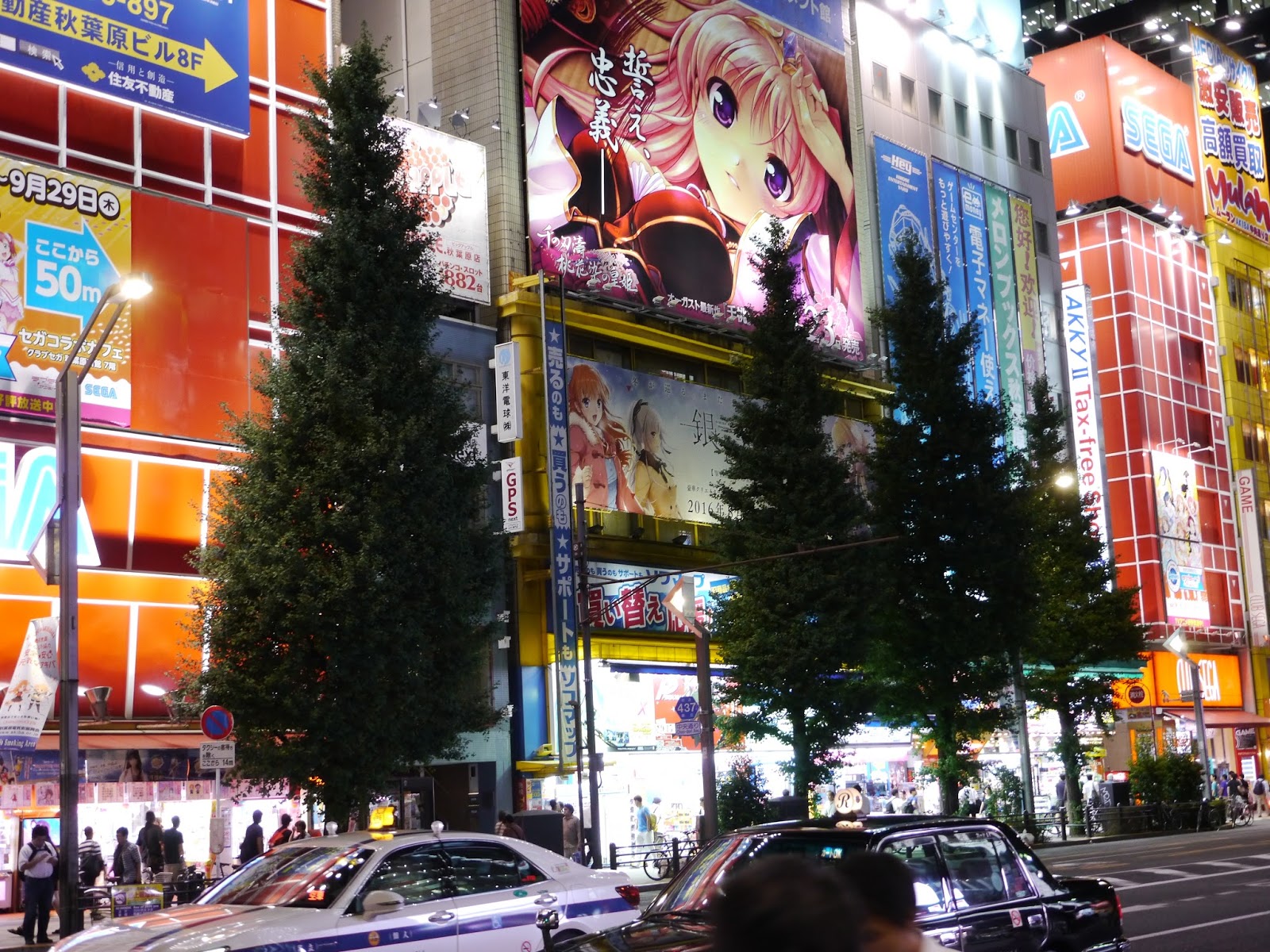
Tokyo is an enormous city. Everything is bigger here, everything moves faster, and everything screams for your attention. Advertising covers entire buildings, especially in the electronics district of Akihabara shown below, and on the small clips on subway handles. Packaging is always as loud as possible; cookies, tiny bits of chocolates, and almonds are available in individually wrapped in brightly printed candy wrappers. Apples are wrapped in a foam net, placed on a plastic tray, then shrinkwrapped, and finally put in a plastic bag at the checkout - and sell for $4 each. I am leaving a trail of brightly colored trash and do not feel good about it.

Restaurants often have plastic simulacra of all dishes out in the window. Amazingly, the food is then exactly as large and carefully prepared as the display version. Compare the beautifully photographed hamburgers on US burger chain menus and the sad, wilted mush you'll actually find on your plate. Many restaurants have call buttons that you can press to have a waiter at your table within seconds. I have had the pleasure to eat pizza with chopsticks (although I was probably the only one). When I have the choice I'll always go for Japanese cuisine of course, it's one of the best of the world. You haven't eaten sushi unless you have eaten sushi in Japan.

The Japanese are incredibly disciplined. On escalators you stand on the right and walk on the left, and it does. not. happen. that someone violates that rule. I have seen traffic lights where pedestrians form an orderly double line to wait for a green light. Everyone is in a hurry yet everyone is very polite and eager to help. I suppose they are used to foreigners staring at Chinese characters in subway stations the size of Belgium. There's enough English to get by though, at least downtown.